Decentralized Document Verification Protocol
A comprehensive technical overview of the Cornicular protocol for blockchain-based document signing, transfer, notarization, and verification.
Table of Contents
01 · Executive Summary
Cornicular is a blockchain document infrastructure platform for signing, transferring, notarizing, and verifying documents on-chain. It replaces fragmented traditional tools (eSign, file transfer, notarization) with a single unified system anchored in immutable blockchain records. Our tagline: Replace Trust Me with Immutability.
Only cryptographic hashes are stored on-chain; original documents remain private and live in user-controlled infrastructure such as IPFS or Bring Your Own Storage (BYOS). Anyone can independently verify document authenticity, and every change is permanently recorded: nothing can be deleted or modified without a trace.
The protocol spans nine product categories: eSignature, blockchain document transfer, notarization, IPFS storage, eKYC compliance, contract intelligence, audit trail, file provenance, and blockchain consortium. This white paper documents the technical architecture, multi-chain strategy, governance roles, and access model of the protocol.
02 · Problem Statement
Traditional document management relies on centralized authorities, creating single points of failure and limited transparency. Organizations juggle separate tools for eSigning, file transfer, and notarization, producing fragmented, manual records:
Current Challenges
- •Centralized storage: Documents held in central repositories become honeypots for breaches and are vulnerable to tampering
- •Hard to verify authenticity: Provenance depends on manual records and on the issuer, who can dispute claims after the fact
- •Manual tamper detection: No cryptographic way to detect document modifications automatically
- •Fragmented history: Ownership and version history are scattered across disconnected systems with no unified timeline
These challenges highlight the need for a decentralized, transparent, and user-controlled approach that cryptographically protects integrity, keeps content private, and lets anyone verify documents independently.
03 · Proposed Solution
Cornicular addresses these challenges with a unified platform that combines cryptographic security with decentralized verification:
Document Signing
Collect digital signatures with an immutable on-chain audit trail. Each signed document produces a unique certificate ID anchored on-chain and remains legally binding through cryptographic records.
Cryptographic Hashing
Generate SHA-256, Keccak-256, BLAKE3, or RIPEMD-160 fingerprints of document content. Hashes are anchored on-chain, so even a single-byte change is detected.
Independent Verification
Anyone can verify authenticity by uploading the file, entering the hash, looking up the document ID, or scanning the QR code. Records reflect ACTIVE, SUPERSEDED, REVOKED, or REMOVED statuses.
Documents move through a single five-step flow: upload and sign, share and collect, compute the hash, register on-chain, and verify. Because gas fees are abstracted on paid plans, no cryptocurrency knowledge is required.
04 · System Architecture
The Cornicular architecture consists of three layers: blockchain, backend, and frontend.
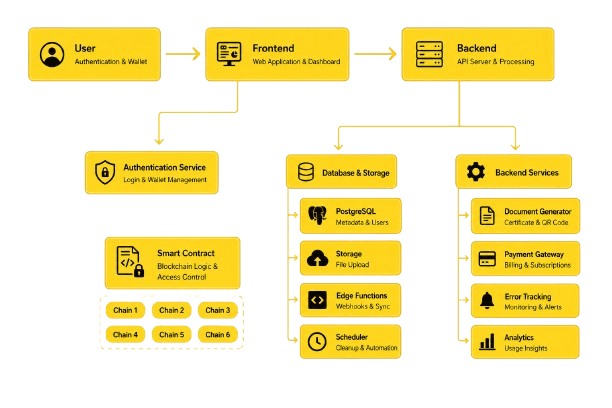
The Blockchain Layer runs Solidity smart contracts (CornicularRegistry) on EVM-compatible networks. It uses AccessControl (DEFAULT_ADMIN, ISSUER, PAUSER), Pausable, and EIP-712 registerWithSignature, with document statuses ACTIVE, SUPERSEDED, REVOKED, and REMOVED. The contract is deployed on Base (8453) and Base Sepolia (84532).
The Backend Layer orchestrates the REST API on Express, stores metadata in Supabase (PostgreSQL), generates PDF certificates, and derives certificate IDs from document hashes. The Frontend Layer is built with Next.js for the landing page, dashboard, and verification portal, using Privy authentication, React Query, and Redux Toolkit.
05 · Consensus and Multi-Chain Strategy
Cornicular supports multiple EVM-compatible networks and lets users select the chain that matches their security and cost requirements:
Layer 1 Anchoring
High-value documents can be anchored on Ethereum mainnet for maximum security and immutability.
Layer 2 Optimization
Routine verifications and high-volume operations use Layer 2 networks like Base and Arbitrum for reduced gas costs while maintaining strong security guarantees.
Supported networks include Ethereum, Base, Base Sepolia (testnet), Arbitrum, Polygon, and custom enterprise networks. Multi-chain verification keeps the protocol available even if individual networks experience congestion or downtime.
06 · Privacy and Data Protection
Privacy is foundational: only hashes and minimal metadata are anchored on-chain, never the raw document.
Privacy Principles
Zero-Knowledge Verification
Verify document authenticity without revealing content
End-to-End Encryption
All document transfers are encrypted in transit and at rest
Data Minimization
Only cryptographic hashes and metadata are stored on-chain
Audit Trail
Complete verification history without content exposure
Storage is flexible and user-controlled: IPFS for decentralized, content-addressed availability, Bring Your Own Storage (BYOS) such as Google Drive, AWS S3, or custom providers, and custodial storage managed by the platform. In every option, only the cryptographic proof is anchored on-chain.
07 · Pricing and Access
Access is credit-based and requires no cryptocurrency knowledge: gas fees are abstracted on paid plans, and each registration and signature consumes credits according to the tier.
| Plan | Price | Includes |
|---|---|---|
| FREE | $0 | 100 credits, standard hashing, single network |
| PRO | $29/mo | More registrations, digital signatures, API access |
| PREMIUM | $59/mo | Unlimited registrations, advanced features |
| STARTUP | $99/mo | Higher limits, team-based |
| CORPORATE | $299/mo | Enterprise API, SSO, audit logs, SLA |
| CUSTOM SCALE | Custom pricing | Bespoke infrastructure, unlimited scale |
Plans scale from personal to enterprise: FREE, PRO, PREMIUM, and STARTUP for individuals and teams, and CORPORATE and CUSTOM SCALE for organizations requiring enterprise API access, SSO, audit logs, and service-level agreements.
08 · Roadmap
Q1 2026 - Foundation
- ▸Smart contract development & audit
- ▸Base Sepolia testnet deployment
- ▸Core API development
- ▸Dashboard beta launch
Q2 2026 - Launch
- ▸Base mainnet deployment
- ▸Public beta launch
- ▸eSignature and notarization modules
- ▸IPFS and BYOS storage options
Q3 2026 - Growth
- ▸Blockchain document transfer
- ▸eKYC compliance module
- ▸Audit trail and file provenance
- ▸Developer SDK and API expansion
Q4 2026 - Scale
- ▸Enterprise consortium networks
- ▸Contract intelligence
- ▸Multi-chain expansion (Ethereum, Arbitrum, Polygon)
- ▸Regulatory compliance framework
09 · Governance Model
Governance is enforced on-chain with role-based access control (AccessControl):
Admin Role
Full protocol management. Controls contract parameters, access roles, and emergency actions (DEFAULT_ADMIN).
Issuer Role
Authorized entities that can register and revoke documents. Issuer status can be gated by KYC verification.
Pauser Role
Emergency pause capability for critical security incidents. Can halt all protocol operations if needed.
For enterprise deployments, governance can be extended to private consortium networks with configurable roles across multiple organizations, maintaining full auditability and regulatory compliance.
10 · Risk Analysis
Like all blockchain-based systems, Cornicular faces risks that are managed defensively:
Smart Contract Risk
Mitigated through multiple independent audits, formal verification, and a bug bounty program.
Network Dependency Risk
Reduced by multi-chain support: verification remains available even if a single network suffers congestion or downtime.
Regulatory Risk
Addressed through compliance-first design, optional KYC, and jurisdictional flexibility.
Quantum Computing Risk
Future-proofed through hash algorithm agility and planned migration to quantum-resistant algorithms.
11 · Conclusion
Cornicular replaces trust-based document management with cryptographic immutability: comprehensive eSignature, transfer, notarization, and verification in one unified, privacy-first platform.
We invite developers, enterprises, and individuals to join us in building a more trustworthy and transparent world - where document integrity is guaranteed by mathematics, not by trust.